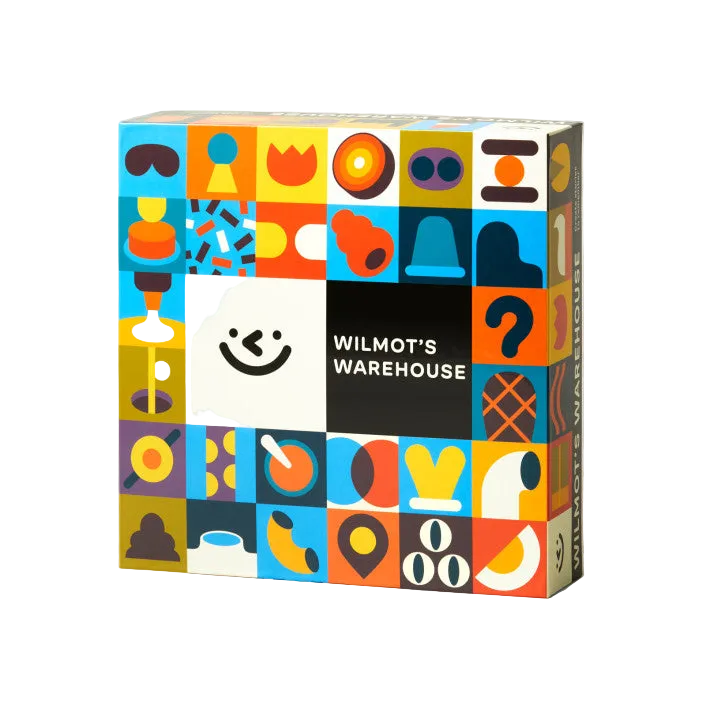
Wilmot's Warehouse
Wilmot's Warehouse
Create an absurd story together about 35 product tiles, place them face down in the warehouse and then race against the clock to find everything.
Sold out
Laat je e-mail achter en we sturen je een bericht zodra dit product terug op voorraad is.
Couldn't load pickup availability

What is the game about?
Welcome to A5 Logistics. You're the newest employee in a warehouse full of peculiar products—a blue horse, a beaver corpse, an emo robot—and it's your job to store everything and retrieve it quickly when customers call. The problem: once a tile is placed, it's turned over and no one is allowed to look at it again. The only way to find everything is to build a shared narrative in your head—the more absurd the better—that places each tile in a collective memory. Wilmot's Warehouse is based on the video game of the same name by Ricky Haggett and Richard Hogg, but the board game version takes a unique approach: less organizing, more collaborative storytelling and the art of memory.
How do you play the game?
The Shift Supervisor draws product tiles one by one from the deck; the team looks at each tile, names its image, and creates a story or mnemonic to remember its location. The tile is placed face down on the board, with adjacent tiles further branching out the storyline. Some rounds include Mandatory Idea cards that impose additional rules, such as only half of the players being allowed to look at a tile. After all 35 tiles are in place, players have five minutes to place customer cards—images of each product—on the correct face-down tile. Incorrect or missed tiles result in penalty points; at the end, a performance review assesses the team's performance.
This is the ideal game for...
You can play this game with 2 to 6 players, from 6 years old. The duration is approximately 30 minutes. The language of the game is English.
More information can always be found at BoardgameGeek. The EAN code is .
How is the game experienced?
Wilmot's Warehouse is one of CMYK's most surprising releases of 2024, proving once again that this label is a master at distilling great experiences from minimal rules. While memory games are traditionally individualistic and frustrating, the cooperative setup makes memorization collective and enjoyable: no one has to remember everything; the shared story does the work. Reviewers are unanimously enthusiastic about the absurd sentences the game elicits and the unique atmosphere that varies per group. For the right group—diverse, creative, and willing to engage in collective nonsense—this is one of the most original and joyful cooperative experiences of recent years.